












Outfitting a crew is a different purchase from buying yourself a shirt. The garments go on five or six days a week, sit under a tool belt, get dragged against studs and scaffold, and come out of the wash looking older every month. ShirtsBargain’s construction workwear category covers the shirts, polos, outer layers and hi-vis pieces that hold up to that, in the quantities you need when the order is for twelve people or two hundred.
Below, we've laid out how to think about the category before you start filtering: what your crew actually wears, what separates a work garment from a casual one, and how the job site itself narrows the choice.
Find Construction Workwear That Performs on Every Job Site
Many crews use a combination of everyday work shirts and more durable outer layers, depending on job requirements and climate. There's the daily layer people ruin - tees and long-sleeve shirts that get replaced on a schedule - and there's the layer that has to last, meaning jackets, vests and anything the company embroiders and expects to see for two or three seasons.
Buy those two tiers differently. Overbuying on the daily layer wastes money on garments that will be paint-stained by August. Underbuying on the outer layer costs more, because a jacket that fails in November gets replaced in November, at whatever price is available.
Construction work apparel also has to survive the laundry. Workwear may go through frequent laundering, so fabric durability, stitching and care requirements are important considerations, which is why fabric and stitching matter more than the product photo.
Essential Construction Clothing for Everyday Work
The core of most orders is a short-sleeve tee. It's the cheapest garment across the board, the one that gets the company name printed on it, and the one that determines whether people are comfortable in July.
Long-sleeve shirts do more work than crews expect. They cut sun exposure on framing and roofing jobs, take the abrasion that forearms otherwise absorb, and lightweight, breathable long-sleeve shirts can provide added sun coverage and may be comfortable for outdoor work in direct sunlight.
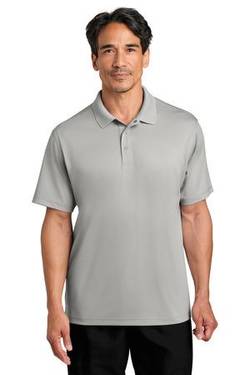
Polos serve the part of the company that meets people. Superintendents, project managers, estimators walking a client through a punch list. A polo reads as company representation in a way a tee doesn't, which is why plenty of contractors run polos for supervisors and tees for the field. If you're outfitting an office alongside the crew, our corporate uniforms selection covers the front-of-house side of the same order.
Outerwear is where the money goes. Hooded sweatshirts and full-zip fleece handle spring and fall; heavier jackets handle winter. A full zip comes off without knocking a hard hat loose, which is a small thing that matters on a site.
Anything worn near traffic, heavy equipment or an active roadway falls under a separate set of rules. Those garments live in our construction hi-vis uniforms category, because high-visibility apparel is graded against a published standard rather than chosen by color preference.
Key Features to Look for in Construction Workwear
Check the seams before anything else. Double-needle stitching can improve durability at high-stress areas such as hems, sleeves and shoulders. Single-needle construction is common on cheap blanks and shows up fast under work conditions.
Fabric weight tells you more than the fiber name. A heavier knit resists tearing and holds its shape through repeated washing, but it also holds heat, so the heaviest option is not automatically the right one for a summer crew. Compare the listed ounce weight between styles when shortlisting good picks.
Polyester and polyester blends can offer good shape retention, quick drying and durability through repeated washing. It resists abrasion, dries faster and fades more slowly than all-cotton. Cotton can offer a soft, comfortable feel, while overall breathability depends on fabric weight, construction and blend. Blends exist because most crews need some of both.
A few practical points that don't show up in a spec sheet:
Mid-tone and darker colors hide dirt and stains; light grey and white show every mark by the second week.
Loose isn't the same as mobile. Reaching overhead all day is about shoulder and armhole construction, not going up a size.
Set-in sleeves and raglan sleeves move differently. Raglan sleeves can provide a different range of shoulder movement than traditional set-in sleeves, depending on the garment's construction and fit.
If the shirts are getting decorated, a flatter, tighter knit surface prints cleaner than a heavily textured one.
Outdoor Workwear Built for Every Season
Construction is one kind of outdoor work. Landscaping, utility, survey, municipal and delivery crews spend just as many hours outside, and their outdoor work clothing has to solve the same problem from a different angle: the weather changes during the shift, and nobody drives back to the shop to change.
That single fact drives most outdoor workwear decisions. A crew that starts at 6 a.m. in the low 40s and works through an afternoon in the 70s cannot be dressed in one garment.
Lightweight & Layered Clothing for Changing Weather
Build the order in three parts rather than buying one heavy piece.
The base is a tee or long-sleeve shirt that has to work on its own by midday, so it should be light enough to be the only thing someone is wearing at 2 p.m. The mid layer, usually a hooded sweatshirt or fleece, covers the morning and comes off around ten. The outer shell handles wind and moisture.
The mistake is spending the whole budget on a heavy insulated jacket. It's the garment worn for the fewest total hours in most climates, and it gets taken off and left in a truck by mid-morning anyway. A mid-weight layer that stays on longer usually does more for a crew than one very warm coat.
Full-zip styles beat pullovers for outdoor work for one reason: temperature control. A zip can be opened halfway when someone warms up. A pullover is on or off, and taking it off usually means removing a hard hat or safety glasses first.
Outdoor Work Clothing for Landscaping, Utilities & Field Teams
Landscaping crews are hard on garments in a specific way. Sap, sun, string trimmer debris and constant kneeling and bending. Long sleeves are common through the whole summer here, not despite the heat but because of sun exposure across an eight-hour shift.
Utility and roadway teams have less freedom of choice. Workers exposed to roadway traffic or construction vehicles may be required to wear compliant high-visibility safety apparel based on applicable regulations and a workplace hazard assessment. So employers should select high-visibility apparel that provides the required level of visibility for the specific work environment and remains compliant when worn as a complete system.
Survey, inspection and field service teams sit somewhere in the middle. They're outside all day, but they're also standing in a client's driveway or a homeowner's yard explaining what they found. Polos tend to win in this group, with outerwear that carries the company name clearly.
Municipal and facilities crews usually need the widest size range in one style, because the group is bigger and more varied than a specialist crew, and everyone is expected to look like part of the same department.
Shop Trusted Workwear Brands at ShirtsBargain
Two names come up most often when contractors ask about construction work clothes brands, and they cover different halves of a typical order.
CornerStone & Carhartt Workwear for Tough Job Site Conditions
CornerStone is a work line rather than a casual line adapted for work, which shows up in the details buyers care about: work shirt construction, hi-vis compliance and garments built around the assumption that they'll be laundered constantly.
It's the brand to start with for the pieces that have to last, particularly anything a crew wears near equipment or traffic. Browse the full CornerStone range in ShirtsBargain to compare the work-specific styles against what you're currently buying.
Carhartt needs no introduction to the construction industry. The brand has been around for decades offering super-durable styles befitting the kind of work at construction sites and other physically demanding roles.
Port & Company Styles for Comfortable Everyday Workwear
Port & Company covers the other half of the order. Value-priced tees and fleece for the layer that gets replaced regularly, which is where most of the unit volume in a crew order actually sits.
On a fifty-person crew, the difference between a $6 tee and a $12 tee across three shirts each is $900. That's the calculation Port & Company is built for. See the current Port & Company selection in ShirtsBargain for basics you can reorder without renegotiating your budget every quarter.
Which Workwear Is Right for Your Team?
The honest answer is that most companies need two or three different setups, not one. A general contractor with framing crews, a survey team and an office isn't dressing all three the same way, and trying to force a single style across the company usually produces a garment nobody is happy in.
Sort your people by where they spend the day and what they touch. That gets you to the right construction workwear clothing faster than sorting by job title.
Choosing Apparel for Indoor Construction vs Outdoor Projects
Interior trades work in a controlled temperature and a dirtier environment. Drywall, paint, dust and adhesive. The garments don't need weather protection but they get filthy, which pushes toward cheaper shirts replaced more often, and darker colors.
Commercial construction on an open frame is a different climate entirely. Wind, sun and no shade, plus weather that changes as the building goes up. Layering matters here more than anywhere.
Road work and anything near active traffic is governed by visibility requirements first and comfort second. Choose within the compliant range, then optimize for the weather.
Field operations, service and utility crews carry a fourth requirement: they're seen by customers. Their work clothes for construction workers still need to survive the job, but they also need to look like a company sent them.
Workwear That Supports Safety, Comfort & Productivity
Construction safety wear clothing is the one part of this category where preference doesn't decide the answer. High-visibility apparel is rated against ANSI/ISEA 107, and the class tells you what the garment is approved for. The appropriate ANSI/ISEA performance class should be selected based on a hazard assessment that considers traffic speed, proximity to vehicles, lighting, weather and work conditions, with sleeves and more background material. A bright yellow shirt that isn't rated is not compliant apparel, whatever it looks like from a distance.
Comfort is a safety issue too, though it's rarely discussed that way. A worker who is overheated in a heavy shirt rolls sleeves up, unbuttons, or takes the layer off entirely. Comfortable, properly fitting workwear may make workers more likely to wear garments as intended throughout the workday.
Fit affects the same thing. Sleeves that catch, hems that ride up when reaching overhead, and shoulders that bind all produce workarounds. The best workwear on a job site is the workwear that stays on the way it was designed to be worn.
Buy Construction & Outdoor Workwear in Bulk from ShirtsBargain
Buying wholesale changes the arithmetic on a crew order. Bulk purchasing can reduce per-unit costs depending on the style, quantity and supplier pricing, but more usefully, you stop making the same decision every few months. One style choice, one size run, one reorder.
Anyone searching for the best outdoor workwear will find plenty of opinion and very few specifics. The practical version: pick the two or three styles that fit your climate and your work, buy them deep, and stay with them long enough that you know how they wear.
Bulk Workwear Solutions for Contractors & Growing Businesses
Order for the crew you'll have in four months, not the one on site today. Construction headcount moves with the schedule, and the shirt that's easy to buy in March is not always the one still available in inventory in September.
Build in overage. Consider keeping a reasonable number of extra garments based on expected hiring, replacement needs and your crew's historical size distribution. It costs less than a rush order and considerably less than a partial reorder that arrives in a different dye lot.
Bulk ordering also makes it realistic to run different garments for different crews, since you're not paying retail pricing on any of them. Landscaping in long sleeves, framing in tees, supervisors in polos, everyone in the same company color.
Reliable Apparel for Everyday Jobs & Long-Term Team Programs
The value of a uniform program is repeatability. A new hire in month seven should get the same shirt everyone else is wearing, in the right size, without a purchasing conversation.
That's mostly about style selection. Choose garments with a size range that covers your actual crew, including extended sizes, and check that before you fall for a color. A shade that stops at 2XL is no use to a company where four people need 4XL.
Watch dye lots on anything you reorder in a signature color. Shirts bought a year apart in the same color can read as slightly different shades side by side, which is why buying deep once beats topping up four times.
Ready to price out a crew order? Start with the styles in this category, or browse the wider range at ShirtsBargain if you're building a program that runs past the job site.